
Resin Barcode Ribbons
Maximum durability for synthetic labels in hostile conditions
A resin ribbon is a thermal transfer ribbon coated with a resin-based ink. It is the most durable grade: on the right label, the print stands up to chemicals, solvents, abrasion and outdoor weather. It needs a synthetic label such as polyester or polypropylene, more printhead heat and slower print speeds, and it costs more than wax or wax-resin, so choose it when the label has to survive something, not as a default.
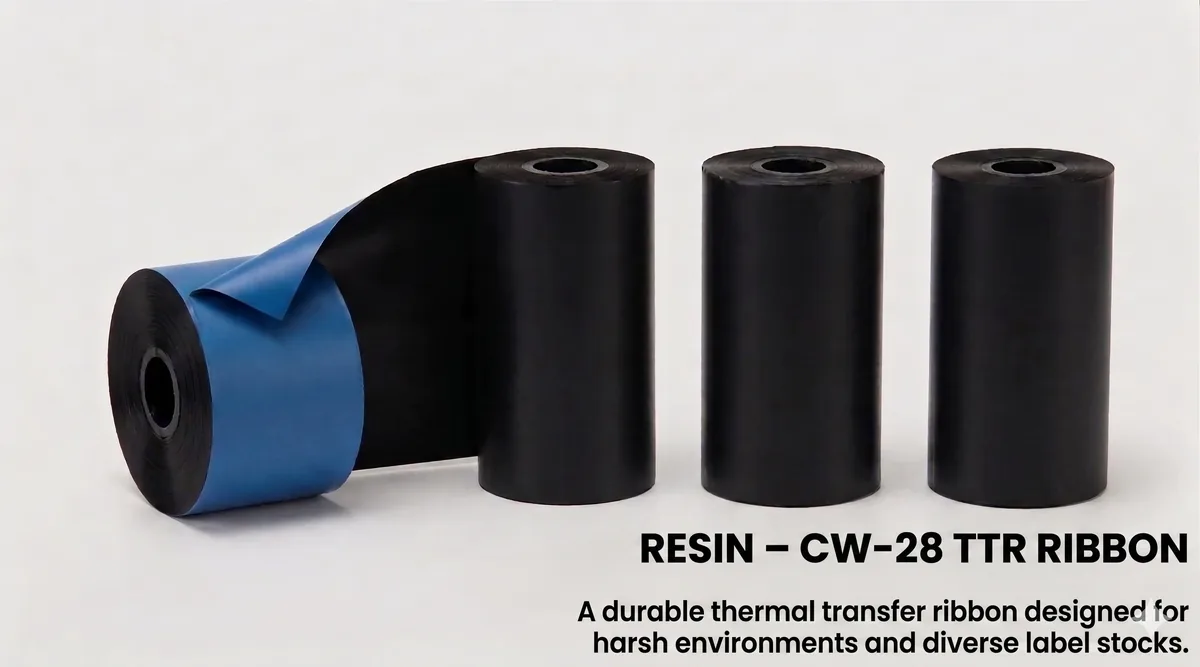
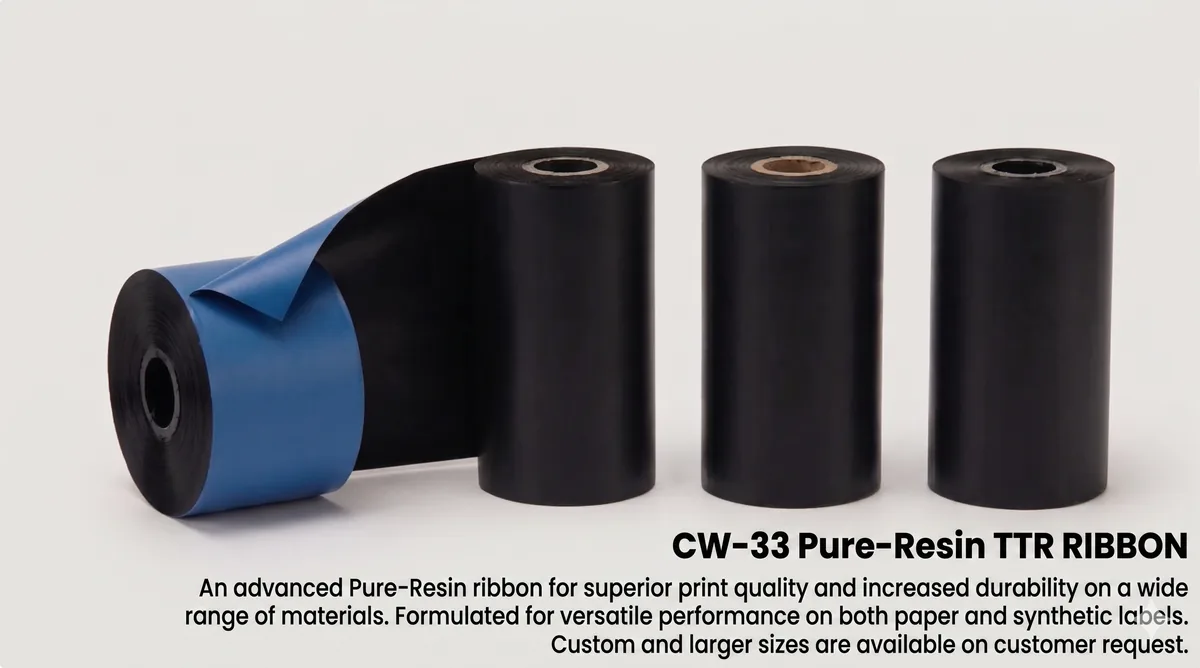
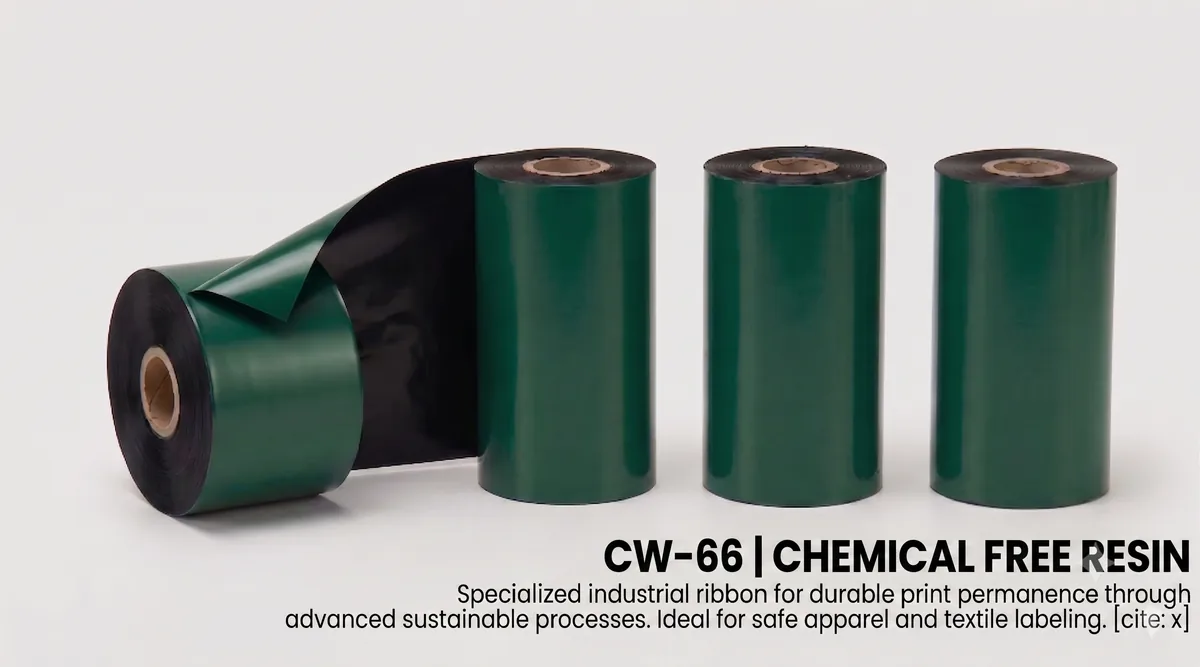
A resin ribbon has a hard resin ink that bonds to synthetic labels such as polyester (PET), polypropylene (PP) and polyimide, and resists chemicals, solvents and abrasion. We supply CW-28 (standard), CW-33 (withstands sterilisation) and CW-66 (chemical-free). Do not use it on paper labels; wax-resin is the better choice on paper.
What resin ribbon is and how it prints
Resin ribbon is built like other thermal transfer ribbon: a thin polyester film, an ink layer on one side and a back coating on the other. The difference is the ink. Resin is a hard polymer. When the printhead melts it onto the label, it forms a tough layer that bonds to the label surface.
Resin needs a higher transfer temperature than wax or wax-resin, which is why the printer runs hotter and slower. It bonds best to smooth synthetic labels such as polyester (PET) and polypropylene (PP).
What resin resists
Printer makers give resin the same list of strengths: resistance to oils, solvents and harsh chemicals, resistance to severe abrasion, and resistance to sunlight and weather. That is why it is the usual ribbon for outdoor labels and for labels that meet chemicals.
The ribbon is only half of the pair. The label material and its adhesive set the limit, and a resin print on a label that curls or lets go still fails. If your label has a written requirement, such as a solvent, a temperature range or a sterilisation cycle, test the exact ribbon and label together before you order in volume.
Resin needs the right label
Resin works best on synthetic labels: polyester, polypropylene and other films. Printer makers say resin ribbon suits all synthetic materials and some top-coated labels and tags. On ordinary paper it is usually the wrong buy: the ink is made to bond to smooth plastics, and the extra cost gets you nothing. If you need a tougher print on paper, the answer is wax-resin.
If you are not sure what your label is made of, send us a piece. We tell you which grade to test, and we send a free sample so you can check it on your own printer.
CW-28, CW-33 and CW-66
We offer three resin grades. CW-28 is our standard resin grade. CW-33 is our top resin grade, and it withstands sterilisation, so it is the one to test first for medical and laboratory labels. CW-66 is our chemical-free resin grade.
The grade table on this page lists the label materials each one prints on. Because the label sets the limit as much as the ribbon, ask for a sample of the grade you are considering and run your own sterilisation or solvent test.
Standards buyers ask about: UL 969 and BS 5609
If a customer's specification names a standard, that standard tests a whole label system, not the ribbon on its own. UL 969 is UL's standard for marking and labelling systems, used for the permanent labels on electrical and electronic products. BS 5609 is the British Standard for printed adhesive labels used at sea, and it tests resistance to marine immersion, weathering, temperature cycling and abrasion. Printer makers publish which of their labels are approved with which of their ribbons, so an approval belongs to a pair, not to a ribbon alone.
If you need a ribbon for a labelling standard, send us the requirement and your label material, and we send a free sample for you or your label supplier to put through the test.
Printing resin: more heat, slower speed
Resin needs more printhead heat and a slower print speed than wax or wax-resin. Printer makers say resin needs lower print speeds than the other grades. Run resin at wax settings and the print comes out weak and rubs off, which defeats the reason you bought it.
Raise darkness in small steps, and stop at the lowest setting that gives a barcode that scans. Too high a setting can burn through the ribbon and wear the printhead early, and slower speeds usually give better print quality. Cleaning steps are in our printhead cleaning guide.
Where resin earns its place
Printer makers list resin for automotive parts, chemical drums and containers, healthcare and laboratory items, electronics and circuit boards, logistics and outdoor asset tags, food and beverage packaging, and horticulture tags. Care labels on garments use a separate wash care ribbon, covered on its own page.
Is resin worth the extra cost?
Printer makers note that a premium wax-resin comes close to resin durability on some labels. So before you move to resin, test a premium wax-resin on your own label. If it passes your rub, wipe and chemical test, it is the cheaper choice.
If it does not pass, or your label is polyester, polypropylene or another film that meets harsh chemicals, heavy abrasion or long outdoor exposure, resin is the right ribbon, and a failed label costs more than the ribbon. For sterilisation, CW-33 is the grade that withstands it.
How to test a resin print before you buy
Print 20 labels on your own printer with the ribbon and label you plan to use. Then do to them what they will meet in real use: rub them hard with a thumb, wipe them with the solvent or cleaner used on your site, soak or wash them if they will get wet, and run one through your sterilisation or temperature cycle. Keep one untouched label to compare, and scan the barcodes after each test. Printer makers say the same on their own data sheets: pre-test every ribbon for your end use.
Resin, wax-resin and wax: the short version
Wax is the simplest and most economical ribbon. It suits paper labels, prints at the highest speeds and copes with little or no chemical or abrasion exposure. Wax-resin suits select papers and matte synthetic labels, prints at moderate speeds and copes with moderate abrasion and a wide range of chemical contact. Resin suits synthetic labels, prints at the lowest speeds and copes with harsh to extreme chemical exposure and heavy abrasion.
In short: pick wax for paper that stays dry, wax-resin for labels that get handled, and resin when the label has to survive its environment. Our wax vs wax-resin vs resin guide goes through the three in more detail.
Five questions that pick the right resin ribbon
What is the label made of? Resin wants a synthetic label, so start there. What will it meet: oils, solvents, cleaners, abrasion, sunlight, a sterilisation cycle? Name the worst one. How long must the print stay readable: weeks, a year, the life of the product? Which printer and what size: a ribbon at least as wide as the label, within your printer's limit, with the right core and ink side. And how will you test it: on your own printer, with your own label, before volume.
Send us the answers and we name the grade to test, with a free sample.
Ordering resin ribbon
Send your printer model, label material, width, core size and winding, and what the label must survive. No minimum order on standard sizes, and we send a free sample so you can run your own test before ordering volume.
Resin Barcode Ribbons: grades at a glance
| Grade | Prints on | Typical uses |
|---|---|---|
| CW-28 Resin Barcode Ribbon | Polyester (PET) labels, Polypropylene (PP) labels, Polyimide labels, Film substrates | Chemical drum and container labels; Outdoor asset tracking; Automotive part labels; PCB and electronics marking |
| CW-33 Pure Resin Barcode Ribbon | Polyester (PET) labels, Polyimide labels, High-performance synthetics, Metal-effect labels | Medical device labelling; Outdoor signage barcodes; Chemical and industrial tagging; Long-life asset labels |
| CW-66 Chemical-Free Resin Ribbon | PET polyester labels, PP synthetic labels, Cleanroom-grade labels, High-performance synthetics | Food-contact adjacent labelling; Pharma cleanroom labels; Tagging for eco-labelled products; Export compliance labels |
Which label material prints with resin barcode ribbons
| Label material | Grade |
|---|---|
| Polyester (PET) labels | CW-28, CW-33, CW-66 |
| Polypropylene (PP) labels | CW-28, CW-66 |
| Polyimide labels | CW-28, CW-33 |
| Film substrates | CW-28 |
| Metal-effect labels | CW-33 |
| Cleanroom-grade labels | CW-66 |
| Paper labels | Not resin — use wax-resin |
Not sure? The ribbon selector narrows it in two questions, or see wax vs wax-resin vs resin.
Sizes, cores and winding
| Widths | 25mm – 160mm, custom |
|---|---|
| Lengths | 50m – 600m |
| Cores | ½ inch and 1 inch (punching available) |
| Winding | Inside and outside wound |
| Most ordered size | 110mm × 300m on a 1-inch core |
| Minimum order | No minimum order on standard sizes |
Popular Zebra printers: see the Zebra ZT410 ribbon, Zebra ZT230 ribbon and Zebra GK420T ribbon pages for the size, core and winding each one takes.
Last reviewed: 9 October 2026
Frequently asked questions
What is a resin ribbon used for?+
Synthetic labels that must survive chemicals, solvents, abrasion, sterilisation or outdoor weather: chemical drums, automotive parts, circuit boards, medical and laboratory items and outdoor asset tags.
What is the difference between resin and wax ribbon?+
Wax ribbon uses a soft wax ink for paper labels and prints fast at low heat. Resin ribbon uses a hard polymer ink that bonds to synthetic labels, resists chemicals and abrasion, and needs more heat and a slower speed. Wax-resin sits in between.
Can I use a resin ribbon on paper labels?+
Usually it is the wrong choice. Resin is made to bond to synthetic labels, with some top-coated labels as an exception, and it costs more than wax-resin. For a tougher print on paper, use wax-resin.
Which label materials print with resin ribbon?+
Polyester (PET), polypropylene (PP), polyimide and other films. The table on this page lists which of our resin grades print on each material.
Is resin ribbon waterproof?+
A resin print resists moisture well on a synthetic label, because the ink bonds to the surface instead of sitting on it. Whether the whole label survives water also depends on the label material and adhesive, so test the pair.
Does a resin print fade in sunlight?+
Resin is the usual choice for outdoor labels because it resists sunlight and weather better than wax-based inks. How long a label lasts outdoors also depends on the label material and adhesive, so ask for a sample and test it.
Do I need to change printer settings for resin?+
Yes. Resin needs more heat and a slower print speed than wax. Raise darkness in small steps and stop at the lowest setting that gives a barcode that scans; too high can burn through the ribbon and wear the printhead.
Why does resin print slower than wax?+
It needs more printhead heat and time to melt and bond, so printer makers recommend lower speeds for resin. Slower speeds also usually give better print quality.
What is the difference between CW-28 and CW-33?+
CW-28 is our standard resin grade. CW-33 is our top resin grade, and it withstands sterilisation. The grade table lists the label materials each one prints on.
Which resin ribbon can go through sterilisation?+
CW-33 withstands sterilisation. The label material and adhesive matter as much as the ribbon, so test the exact ribbon and label through your own sterilisation method before ordering volume.
What is a chemical-free resin ribbon?+
CW-66 is our chemical-free resin grade. Tell us what your buyer or export market asks for and we send a free sample to test.
Does a resin ribbon meet UL 969 or BS 5609?+
Those standards approve a specific combination of label material, ribbon and adhesive, not a ribbon alone. We do not state a UL or BS 5609 rating on this page. If your specification needs one, send us the requirement and a label sample and we send a free ribbon sample for your lab or label supplier to test.
How should I store resin ribbon?+
Printer makers' data sheets give about one year as the expected shelf life, stored before use at around 22°C and 50% relative humidity. Buy what you will use within that time.
Is there a minimum order or a sample?+
No minimum order on standard sizes, and a free sample is available.