
Wax Barcode Ribbons
The economy grade for paper labels in ordinary conditions
A wax ribbon is a thermal transfer ribbon coated with a wax-based ink, and it is the simplest, lowest-cost ribbon for a barcode printer. It prints fast, it is gentle on the printhead, and it does a clean job on ordinary paper labels that stay indoors. This page covers what wax ribbon does well, where it stops working, and how to order the right size for your printer.
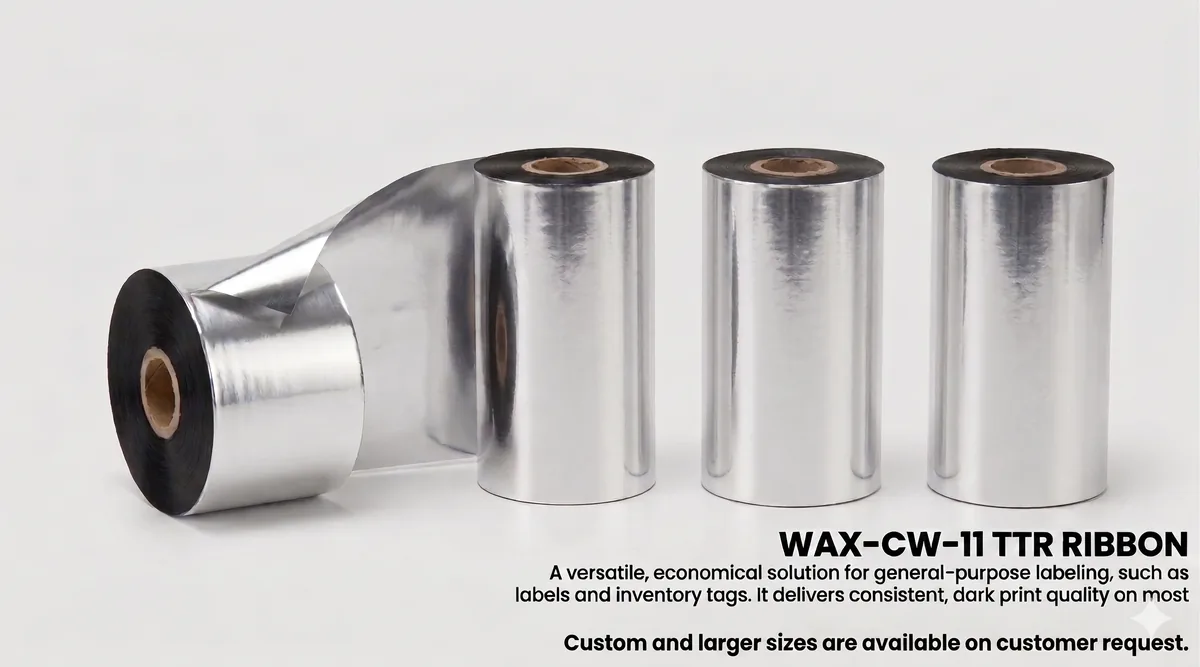
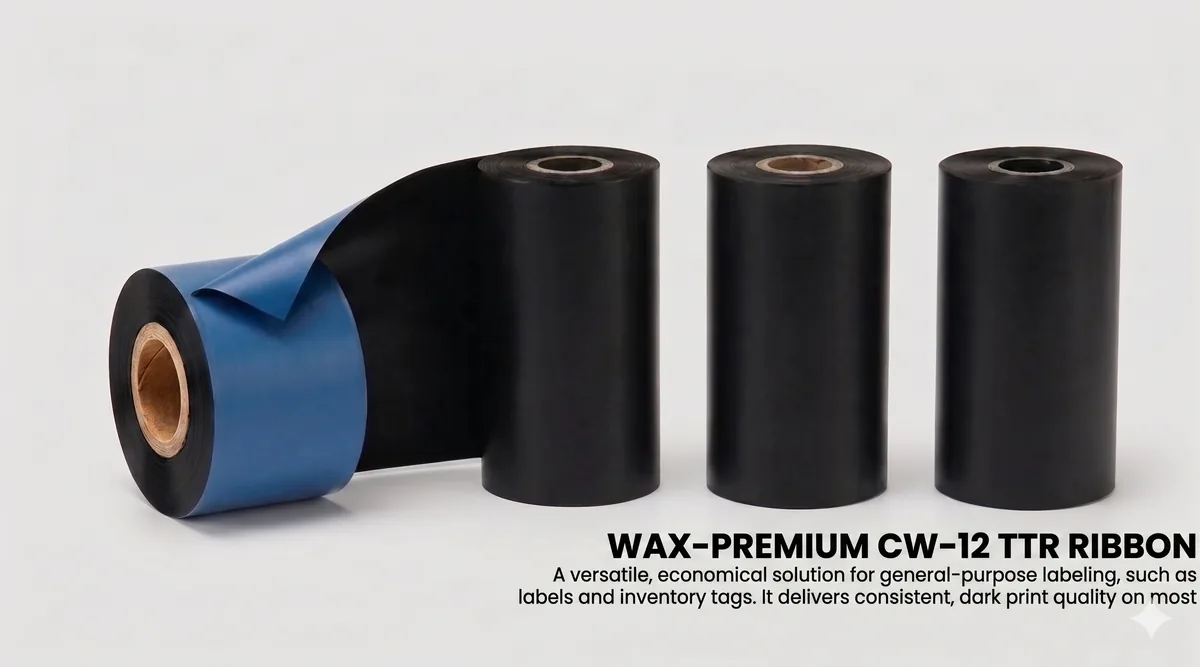
A wax ribbon, with a wax-based ink, is the simplest thermal transfer ribbon, for paper labels used indoors. We supply CW-11 (standard) and CW-12 (premium) for uncoated, matte, semi-gloss and coated paper. Do not use it on polyester or polypropylene labels, or where print is rubbed, wiped, soaked or exposed to solvents; choose wax-resin or resin.
What a wax barcode ribbon is
A thermal transfer ribbon is a thin polyester film with an ink layer on one side and a protective back coating on the other. The printhead heats the back of the ribbon, and the heat melts the ink off the film and onto the label. In a wax ribbon the ink is wax-based, so it transfers at a lower heat setting than the other grades.
The whole ribbon is under 10 microns thick. The back coating does real work: it shields the printhead from heat and static, and a poor one causes friction that can damage the printhead.
We supply wax ribbon in two grades, CW-11 and CW-12, slit to size in our DPCC-approved factory in Delhi.
When wax is the right choice
Choose wax when the label is paper, stays indoors, and is not rubbed, wiped or soaked. Shipping labels, carton marks, retail price tags, inventory barcodes and warehouse rack labels all fit.
Wax is also the fastest grade to print with and needs the lowest printhead heat, so it is the gentlest on the printhead. For a business printing tens of thousands of labels a month, that means the lowest cost per label and no extra durability that you pay for but never use, because the label is scanned and thrown away long before wax would let you down.
Where wax stops working
Printer makers describe wax as the ribbon for paper labels with little or no exposure to chemicals or abrasion, and a standard wax print as only moderately resistant to smudging and scratching. Rubbing, stacking, damp, oil and solvents can all mark or lift it.
Synthetic labels are the other limit. Some wax ribbons are sold for films such as PE and PP, but our wax grades are for paper. For polyester and polypropylene labels, use wax-resin or resin. The same goes for paper labels that get wet, wiped or handled a lot: wax-resin is the next step.
CW-11 and CW-12
Printer makers sell wax in two tiers: a standard wax that is the lowest-cost choice for general paper labels, and a premium wax for sharper print and better smudge and scratch resistance.
In our range, CW-11 is the standard wax grade and CW-12 is the premium wax grade. The grade table on this page lists the paper types each one prints on. If you are unsure, ask for a free sample of both and run them on your own printer and labels.
Do you need a ribbon at all?
Only thermal transfer labels need a ribbon. Direct thermal labels have a heat-sensitive coating and print without one, and loading a ribbon with them causes print problems. A quick scratch test tells the two apart: scratch the label surface quickly and firmly. If a dark mark appears, the label is direct thermal and needs no ribbon. If nothing appears, it is a thermal transfer label.
Two more checks before you order: the printer must be set to thermal transfer mode, not direct thermal, and the ribbon must match the width and winding your printer takes.
Which side is the ink: inside wound or outside wound
A ribbon is coated with ink on one side only, and a printer can use only one orientation. Outside wound means the ink side faces out on the roll (coated side out). Inside wound means the ink side faces in (coated side in). Zebra's industrial printers, for example, take ribbon coated on the outside, and need an optional spindle to run inside-coated ribbon. Other printers may need the opposite, so check the manual for your model.
If you are not sure what you have, peel a label off its liner, press a corner of the sticky side against the outside of the ribbon roll, and peel it away. If flakes of ink come off on the label, the roll is coated on the outside. If nothing comes off, it is coated on the inside. Tell us your printer model and we confirm the winding.
Choosing width, length and core
Choose a ribbon at least as wide as the label, and no wider than your printer allows. A ribbon narrower than the label leaves part of the printhead unprotected, and that part wears out early. For a sense of the limits, Zebra's 4-inch ZT411 takes ribbon up to 110mm wide and its 6-inch ZT421 up to 174mm, both on a 1-inch (25mm) core, with rolls up to 450m.
We slit custom widths from 25mm to 160mm and lengths from 50m to 600m, on half-inch or 1-inch cores, plain or punched (notched), with blue, green, silver, transparent or custom-colour leaders. If your last roll was 105mm × 300m, you get 105mm × 300m back. Our most-ordered size is 110mm × 300m on a 1-inch core.
Printer settings that protect the printhead
Wax needs less heat than wax-resin or resin, so start from a low darkness setting and raise it only until the barcode scans cleanly. Zebra's manuals say the same: set darkness to the lowest setting that gives good print quality. Too high a setting can make the image unclear, stop barcodes scanning, burn through the ribbon and wear the printhead early. Slower print speeds usually give better print quality.
If prints turn faint or patchy, check the settings and the printhead before blaming the ribbon. Cleaning steps are in our printhead cleaning guide.
Faint print, grey lines and missing print: what to check first
Faint or uneven print: check that the ribbon and label are a suitable pair, that the label really is thermal transfer, and that the supplies suit your print speed. Then adjust darkness in small steps.
Fine grey lines on blank labels usually mean a wrinkled ribbon. Reload it correctly, use the lowest darkness that still prints well, and set printhead pressure to the minimum that gives good print quality. Long tracks with no print can also mean a damaged printhead element, which needs a technician.
A ribbon that breaks or melts means the darkness is too high, or the ribbon is coated on the wrong side for your printer.
Storing wax ribbon
Printer makers' ribbon data sheets give 22°C and 50% relative humidity as the storage condition before use, and about one year as the expected shelf life. Buy what you will use inside that time and use the oldest rolls first.
Ordering wax ribbon from Codewell
Send your printer model, label width, core size and winding, and the roll length you want. No minimum order on standard sizes, and we send a free sample so you can test before committing to volume. WhatsApp or call and we quote the same day.
Wax Barcode Ribbons: grades at a glance
| Grade | Prints on | Typical uses |
|---|---|---|
| CW-11 Wax Barcode Ribbon | Uncoated paper, Matte-coated paper | Shipping & logistics labels; Retail price tags; Inventory barcodes; General purpose paper labels |
| CW-12 Premium Wax Barcode Ribbon | Matte paper, Semi-gloss paper, Coated paper labels | High-volume retail labels; Courier & shipping barcodes; Grocery & FMCG labels; Office document labels |
Which label material prints with wax barcode ribbons
| Label material | Grade |
|---|---|
| Uncoated paper | CW-11 |
| Matte / matte-coated paper | CW-11, CW-12 |
| Semi-gloss paper | CW-12 |
| Coated paper labels | CW-12 |
| Polyester or polypropylene | Not wax — use wax-resin or resin |
Not sure? The ribbon selector narrows it in two questions, or see wax vs wax-resin vs resin.
Sizes, cores and winding
| Widths | 25mm – 160mm, custom |
|---|---|
| Lengths | 50m – 600m |
| Cores | ½ inch and 1 inch (punching available) |
| Winding | Inside and outside wound |
| Most ordered size | 110mm × 300m on a 1-inch core |
| Minimum order | No minimum order on standard sizes |
Popular Zebra printers: see the Zebra ZT410 ribbon, Zebra ZT230 ribbon and Zebra GK420T ribbon pages for the size, core and winding each one takes.
Last reviewed: 9 October 2026
Frequently asked questions
What is a wax ribbon used for?+
Paper labels printed in ordinary indoor conditions: shipping labels, price tags, inventory barcodes, warehouse rack labels and carton marks. It is the lowest-cost grade of thermal transfer ribbon.
What is the difference between a wax ribbon and a wax-resin ribbon?+
Wax ribbon has a wax-only ink that suits paper labels. Wax-resin adds resin for a harder print with better scratch, smear and chemical resistance, on coated paper and many matte synthetic labels. Wax-resin needs more printhead heat and prints a little slower.
Do I need a ribbon for my barcode printer?+
Only if your labels are thermal transfer labels. Direct thermal labels print without a ribbon. Scratch the label quickly and firmly: a dark mark means direct thermal, so no ribbon. No mark means thermal transfer, so you need one.
How do I tell which side of the ribbon is the ink side?+
Press the sticky side of a label against the outside of the roll and peel it off. If flakes of ink come away, the roll is coated on the outside. If not, it is coated on the inside. Your printer manual says which one it takes, or send us the model and we confirm.
What width of wax ribbon should I buy?+
At least as wide as your label, and no wider than your printer's maximum. A ribbon narrower than the label leaves part of the printhead unprotected. For example, the Zebra ZT411 takes ribbon up to 110mm wide.
Can I use a wax ribbon on polyester or PP labels?+
Our wax grades are for paper. Some wax ribbons print on PE and PP, but for polyester and polypropylene labels use wax-resin for light synthetics and matte films, or resin where the print must resist chemicals or abrasion.
Is wax ribbon waterproof?+
Not reliably. Wax is made for dry, indoor labels with little rubbing or chemical contact. If the label will get wet, be wiped or be handled a lot, use wax-resin.
Will wax ribbon smudge?+
It can. Under heavy handling, rubbing, damp or oil the print can mark. If your labels are handled or get damp, move to wax-resin.
Why is my wax print faint or patchy?+
Check that the labels are thermal transfer and the ribbon suits them, then check darkness and speed, raising darkness in small steps. Do not push darkness higher than the barcode needs: too high can burn through the ribbon and wear the printhead.
What do grey lines or missing print on my labels mean?+
Fine grey lines on blank labels usually mean the ribbon is wrinkled: reload it correctly, use the lowest darkness that prints well, and set printhead pressure to the minimum that gives good print quality. Long tracks with no print can also mean a damaged printhead element, which needs a technician.
How long can I store wax ribbon?+
Printer makers' data sheets give about one year as the expected shelf life, stored before use at around 22°C and 50% relative humidity. Buy what you will use within that time and check the figure for the ribbon you buy.
What is the difference between CW-11 and CW-12?+
CW-11 is our standard wax grade and CW-12 is our premium wax grade. Both print on paper labels, and the grade table on this page lists the paper types for each. Ask for a free sample of both and test them on your own printer.
Does wax ribbon fit Zebra, TSC, Sato, Honeywell and Godex printers?+
It does for the models on our printer pages when width, core size and winding match; send your model and we confirm the size.
What sizes of wax ribbon can I order?+
Widths of 25 to 160mm and lengths of 50 to 600m on half-inch or 1-inch cores, inside or outside wound; the most common is 110mm × 300m on a 1-inch core. No minimum order on standard sizes.
How many labels does a roll of wax ribbon print?+
Divide the roll length by the label length: a 300m roll gives about 3,000 labels of 100mm when the printer advances ribbon one label length per label.
How do I get a quote for wax ribbon?+
Send your printer model, label width, core size and winding, the roll length and how many rolls. Width, length and quantity shape the quote. No minimum order on standard sizes, and we quote the same day on WhatsApp or by phone.